
Tuesday, February 27, 2007
My home
Ok, I am a bit slow on the posting recently. A lot of things have been going on here at the rodent apartment. I have re-arranged the rooms in which the babies occupy to make sure everyone is in the best spot for temperature and social interaction.
The hedgehogs are best kept in the kitchen, the warmest and darkest spot in the place. The mice are kept in the living room next to the couch for much needed human interaction. The guinea pig is also in the living room with the door to his cage always kept open so as not to feel in-prisoned and allow for easy access to mom and dad. The hamster is kept in the middle between the bedroom and the living room as to allow him peace and quiet with mild interaction, he can be testy if his nap is disturbed. Anyway I took some photos of the new arrangement,
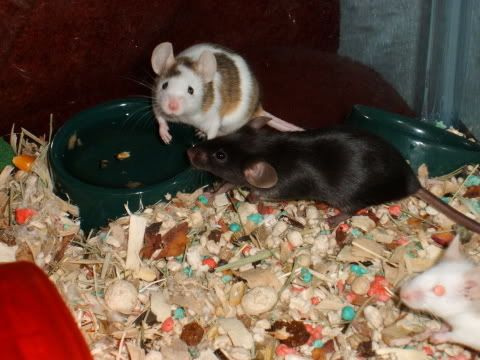
Heres my babies, Moo-latte, Beat and Smokey.
Heres Onion the Guinea Pig's new cage and all the goodies.

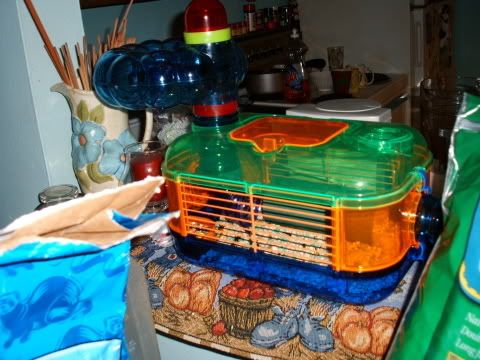
Part of Nickels Habitat, courtesy of S.A.M. Products.
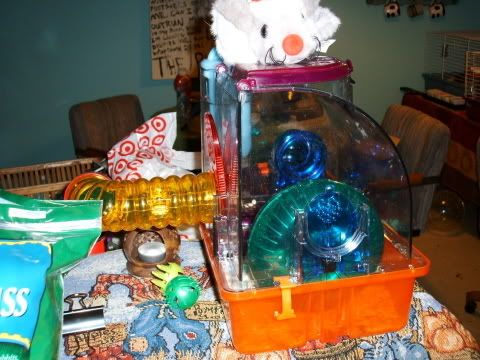
The other part of Nickel the Mouses' Habitat.
Just a cute picture of Blackberry of the House of Sugar, aka "Shh Shh".
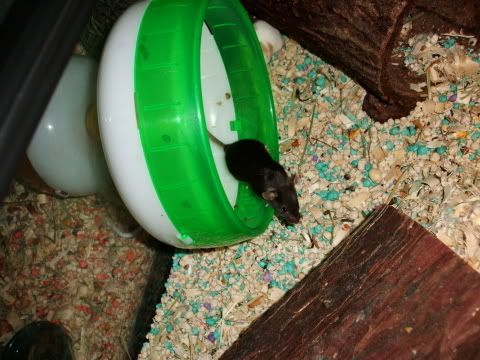
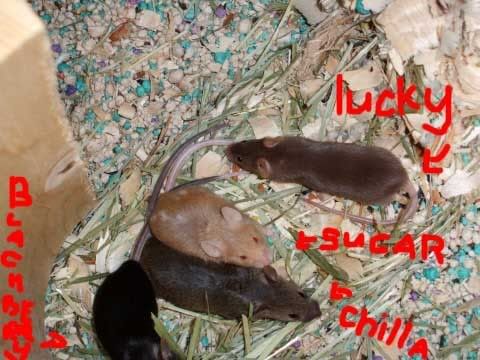
And finally, from the House of Shh....We have Sugar, Lucky, Chilla, and Blackberry.

The hedgehogs are best kept in the kitchen, the warmest and darkest spot in the place. The mice are kept in the living room next to the couch for much needed human interaction. The guinea pig is also in the living room with the door to his cage always kept open so as not to feel in-prisoned and allow for easy access to mom and dad. The hamster is kept in the middle between the bedroom and the living room as to allow him peace and quiet with mild interaction, he can be testy if his nap is disturbed. Anyway I took some photos of the new arrangement,
Heres my babies, Moo-latte, Beat and Smokey.
Heres Onion the Guinea Pig's new cage and all the goodies.
Part of Nickels Habitat, courtesy of S.A.M. Products.
The other part of Nickel the Mouses' Habitat.
Just a cute picture of Blackberry of the House of Sugar, aka "Shh Shh".
And finally, from the House of Shh....We have Sugar, Lucky, Chilla, and Blackberry.
Labels: Fancy Mice Babies litter birth, Guinea pig, hamster, hedgehog, Home
Tuesday, December 26, 2006
Results to chew on
Summary of The "Hogwatch" Project at Lower Moss Wood, Cheshire, from a piece by Jill Key of Manchester Metropolitan University in The Rehabilitator newsletter; Spring 1997.
Following some earlier research by Dr Pat Morris, wildlife rehabilitators were worried that released hedgehogs may be doomed to a rapid death by starvation. Hogwatch began life in the autumn of 1992 with the aim of answering a very simple question: what happens to hedgehogs released from Lower Moss Wood in spring?
Hogwatch uses small radio-transmitters attached to the scruff of the neck to enable the hedgehog to be relocated after release. It has also begun to fit small plastic spool cases with thread to the rump of hedgehogs so that they leave a clear path of where they have been.
The idea is to keep track of the hedgehogs for as long as possible after their spring release. The transmitter locates the animal in its day nest and it is weighed, checked and its thread replenished. In the morning the spool line is mapped and the droppings are picked up. The droppings are for studying: wild hedgehog droppings were compared with those of released Hogs.
Between 1993 and 1995 a total of 22 radio-tagged hedgehogs were released. The fate of the 22 was mixed, but during the first months unfortunately most were lost track of. However three interesting discoveries have been made.
The first is that the weight loss experienced by released hedgehogs appears to be a transitory phenomenon. Typically there is a fall in weight immediately after release, followed by a rise to near or even above the pre-release weight. Day-to-day weight variations reflect time of weighing. Dr Morris found a similar trend in previous studies and suggests that the drop in weight is a result of the increased exercise a released hedgehog has. Also, obesity in released hedgehogs may improve their survival rate by cushioning them against starvation while they re-adjust.
The second is that the wood where the hedgehogs were released was not favoured by the hedgehogs. All the Hogs tracked for some time ended up living in rural villages, nesting under sheds or compost heaps, or sometimes in farm barns and outhouses. The suburban/rural garden appears to offer the hedgehog an ideal habitat, providing food and refuge. Surveys have found that wandering from release sights is common however.
The third discovery was made by Andrew Routh, the Vet. The teeth of hedgehogs pre-release tended to be in a poor state, with a lot of plaque and often gingivitis as well. Could this be due to months on a diet of soft cat food? From the limited data collected, it seemed that wild Hogs ate more beetles than released ones: perhaps because of sore gums and poor teeth in rehabilitated Hogs. Hogwatch looked at admixing an abrasive substance with cat food to keep mouths healthy. The additives that seemed most suitable were: ground egg shells, coir (non-peat compost) and monkey nuts. Whether a diet of cat food mixed with one of these keeps teeth and gums healthy remains to be seen.

Summary of The "Hogwatch" Project at Lower Moss Wood, Cheshire, from a piece by Jill Key of Manchester Metropolitan University in The Rehabilitator newsletter; Spring 1997.
Following some earlier research by Dr Pat Morris, wildlife rehabilitators were worried that released hedgehogs may be doomed to a rapid death by starvation. Hogwatch began life in the autumn of 1992 with the aim of answering a very simple question: what happens to hedgehogs released from Lower Moss Wood in spring?
Hogwatch uses small radio-transmitters attached to the scruff of the neck to enable the hedgehog to be relocated after release. It has also begun to fit small plastic spool cases with thread to the rump of hedgehogs so that they leave a clear path of where they have been.
The idea is to keep track of the hedgehogs for as long as possible after their spring release. The transmitter locates the animal in its day nest and it is weighed, checked and its thread replenished. In the morning the spool line is mapped and the droppings are picked up. The droppings are for studying: wild hedgehog droppings were compared with those of released Hogs.
Between 1993 and 1995 a total of 22 radio-tagged hedgehogs were released. The fate of the 22 was mixed, but during the first months unfortunately most were lost track of. However three interesting discoveries have been made.
The first is that the weight loss experienced by released hedgehogs appears to be a transitory phenomenon. Typically there is a fall in weight immediately after release, followed by a rise to near or even above the pre-release weight. Day-to-day weight variations reflect time of weighing. Dr Morris found a similar trend in previous studies and suggests that the drop in weight is a result of the increased exercise a released hedgehog has. Also, obesity in released hedgehogs may improve their survival rate by cushioning them against starvation while they re-adjust.
The second is that the wood where the hedgehogs were released was not favoured by the hedgehogs. All the Hogs tracked for some time ended up living in rural villages, nesting under sheds or compost heaps, or sometimes in farm barns and outhouses. The suburban/rural garden appears to offer the hedgehog an ideal habitat, providing food and refuge. Surveys have found that wandering from release sights is common however.
The third discovery was made by Andrew Routh, the Vet. The teeth of hedgehogs pre-release tended to be in a poor state, with a lot of plaque and often gingivitis as well. Could this be due to months on a diet of soft cat food? From the limited data collected, it seemed that wild Hogs ate more beetles than released ones: perhaps because of sore gums and poor teeth in rehabilitated Hogs. Hogwatch looked at admixing an abrasive substance with cat food to keep mouths healthy. The additives that seemed most suitable were: ground egg shells, coir (non-peat compost) and monkey nuts. Whether a diet of cat food mixed with one of these keeps teeth and gums healthy remains to be seen.
Labels: hedgehog, rehabilitation, release, starvation
Friday, December 15, 2006
Global warming claims another Hedgehog
I am tired of the inability of this government and others to seriously address the issue of global warming. It is not until it affects the human species that anything major will be conducted. In the meantime our beautiful hedgehog neighbors in the UK are added to the list of causalities consumed by humans decadence. I sometimes feel the human race is like a plague destined to wipe out all the world.
The hedgehogs that could find themselves in trouble this winter are known as autumn juveniles, ones that are old enough to be away from their mothers but too small to hibernate.
The season for these youngsters can start as early as September and is busiest through until the end of November but the present warmer conditions can confuse hedgehogs into thinking its still breeding time and too early to hibernate.
As a result young hedgehogs could suddenly face winter temperatures but not be in strong enough condition to last through hibernation.
Concern is now mounting about the effects of climate change amongst the members of the British Hedgehog Preservation Society, dedicated to helping and caring for these native UK animals or to give them their official latin name, Erinaceus europaeus.
Labels: breeding, global warming, hedgehog, hibernate, juvenile


Shabby Cheap
Origin
Rattitude
Wee Little Beasties
The Fluffy Tribe
Razzles Hog Blog
Rat in a Box
All Things Critters...Especially pet Rats
Kitty Limericks
A Hedgehog Life
Rattie Corner
Diva Kitty and the Fluffies
Vermin Realm
LOL Rats
Oh Rats!
Zing Shui
Fancy Rats
The Art of the Illustrated Rat
The Dapper Rat
You Know Your a Rat Lover When...
Farm Sanctuary
Ratz Realm Rattery
Chelsey's Cozies


Looking for Somethin?
AWARDS

Thank you Abita!

Thank you Karen Jo!

1 Hedgehog
1 Hamster
1 Gerbil
6 Fancy rats
3 Field Mice
2 Guinea Pigs
1 Tabby Cat
Me


January 2007
February 2007
March 2007
April 2007
May 2007
June 2007
July 2007
August 2007
September 2007
October 2007
November 2007
December 2007
January 2008
February 2008
March 2008
April 2008
May 2008
June 2008
July 2008
August 2008
September 2008
October 2008
November 2008
December 2008
January 2009
February 2009
March 2009
April 2009
May 2009
June 2009
July 2009